TL;DR: Teaching children core wilderness survival skills — fire-making, shelter-building, navigation, and signaling — is one of the most evidence-backed ways to build resilience and self-reliance, and 2025 expert guidance emphasizes starting as young as age five with hands-on, scenario-based lessons.
Wilderness survival education for children is having a moment. Enrollment in youth outdoor skills programs rose sharply after the COVID-19 pandemic reshaped family recreation habits, and organizations like the Boy Scouts of America, the Woodcraft League of America, and the National Outdoor Leadership School (NOLS) have all expanded junior programming through 2024 and into 2025. The core message from every credible instructor is consistent: hands-on, age-appropriate outdoor skills training — not reckless exposure to adult risks — is what actually keeps kids safe.
Why Wilderness Survival Skills Matter for Children
Survival skills are not just about emergencies. According to the Woodcraft League of America, structured wilderness education teaches children self-reliance, environmental awareness, and calm decision-making under pressure — competencies that transfer directly to school, sports, and everyday life. A child who knows how to read a topographic map, build a debris shelter, or signal for help with a whistle is a child who has practiced managing uncertainty.
The psychological benefits are equally documented. A 2022 review published in Frontiers in Psychology found that nature-based learning programs consistently improved executive function, emotional regulation, and risk assessment in children aged 5–12. These gains were strongest in programs that included realistic, low-stakes practice scenarios — not classroom lectures alone.
The practical skills themselves form a clear progression:
- Ages 5–7: Stay-put protocol, whistle signaling (three blasts = distress), identifying safe water sources visually, and basic fire awareness.
- Ages 8–10: Map and compass basics, fire-starting with matches and a ferro rod under adult supervision, building a simple lean-to shelter.
- Ages 11–14: Full navigation by map and compass, purifying water with a filter or tablets, foraging identification of five to ten regional edible plants, knot-tying for camp setup.
- Ages 14+: Multi-day trip planning, first aid and improvised splints, rappelling safety, and leading younger children through basic drills.
The National Outdoor Leadership School (NOLS) has used a similar competency ladder in its youth expeditions since the 1980s, and its 2024 curriculum update — documented on the NOLS website — added dedicated modules on decision-making and risk communication for teen participants.
How to Start: Practical Curriculum for Parents
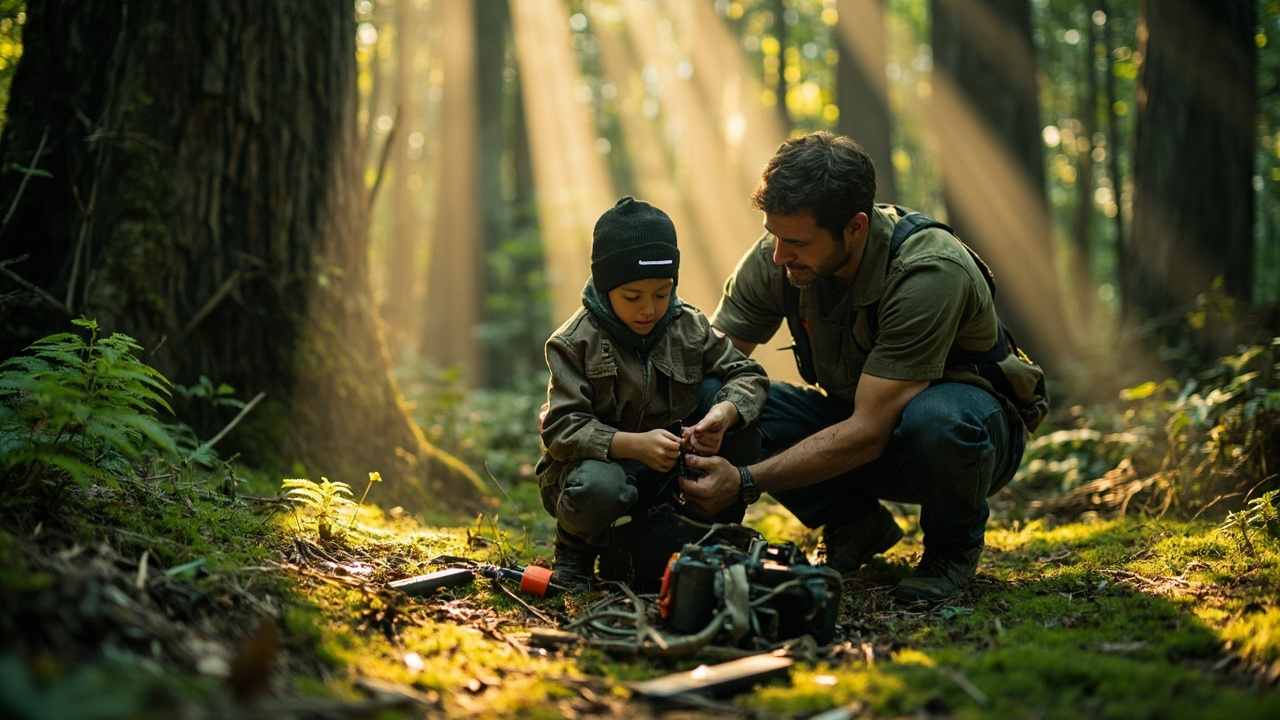
You do not need an organized program to begin. Most foundational skills can be practiced in a backyard, a local park, or a state forest.
Fire Safety and Fire-Making
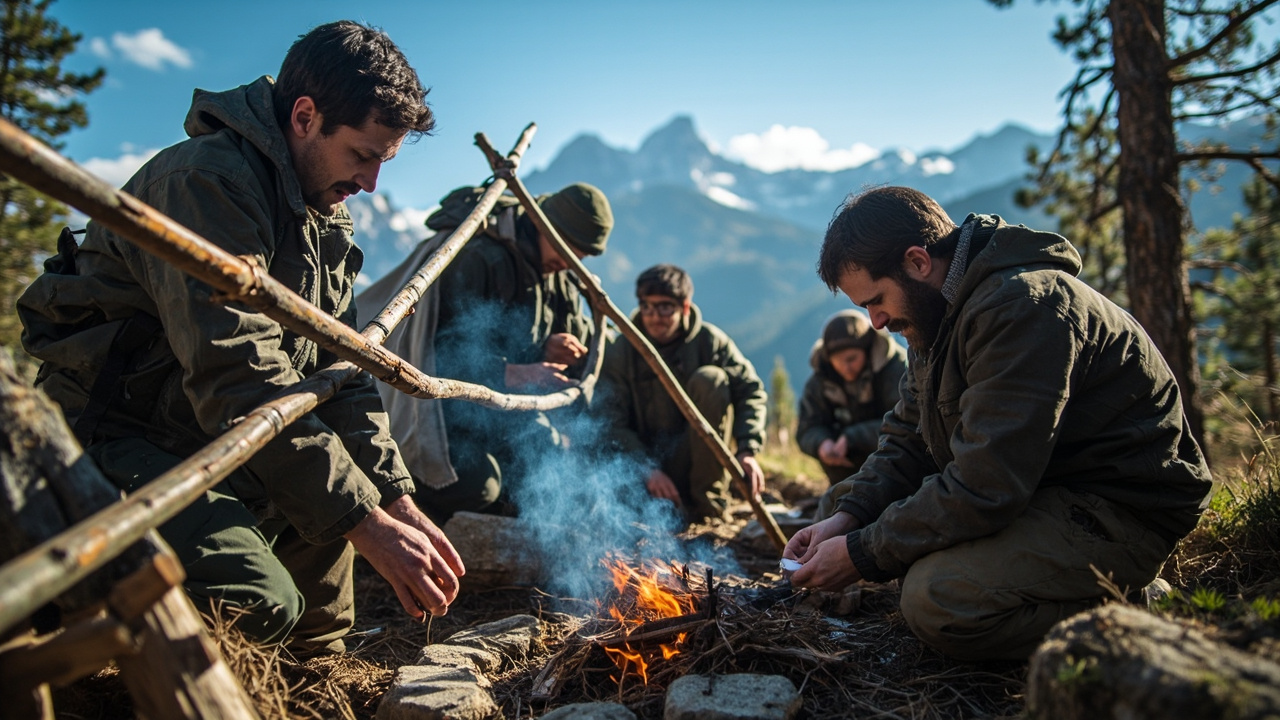
Fire is the skill children are most fascinated by — and the one that demands the clearest adult structure. Start with fire safety: what keeps a fire contained, how to extinguish a campfire fully, and why you never leave one unattended. Once those rules are internalized, introduce fire-starting tools. A ferro rod and tinder bundle is the recommended starting point because it requires deliberate effort and produces a controlled spark rather than an open flame, giving both child and parent more reaction time.
Have children practice with cotton balls and petroleum jelly as tinder before moving to natural materials like dry grass or birch bark. NOLS instructors recommend at least five successful fire-starts in a controlled setting before a child attempts fire-making in a real backcountry context.
Navigation Without a Phone
Smartphone dependency is one of the biggest gaps in modern outdoor preparedness. In 2023, the U.S. Search and Rescue Statistics database recorded that over 40 percent of backcountry rescues involved a party whose electronic navigation device had lost power or signal. Teaching children to read a USGS topographic map and use a baseplate compass addresses this directly.
Start with a simple orienteering exercise: mark three landmarks on a printed map of your neighborhood or local park, then have the child navigate between them using compass bearings. Apps like Gaia GPS can serve as a check, but the child should complete the exercise on paper first.
Shelter Building
A proper debris shelter can hold body heat even in near-freezing conditions. The debris hut — a structure made from branches, leaves, and forest debris — is the gold standard for teaching children because it requires only natural materials and can be built in under two hours. The insulation layer should be at least two feet thick on all sides. Have the child sleep in the finished shelter during a mild evening before relying on this skill in a real emergency.
Signaling and the Stay-Put Rule
Search and rescue professionals consistently emphasize one rule above all others: when lost, stay put. Children who wander cover more ground, obscure their tracks, and become exponentially harder to find. Pair the stay-put rule with active signaling: three whistle blasts, a signal mirror, or a brightly colored tarp laid in a clearing. Practice this at home so the behavior is automatic under stress.
The Gun Safety Line: What Experts Actually Say
A distinct but related debate has emerged in parenting and outdoor communities about whether teaching children to handle firearms in the field is part of wilderness preparedness. It is worth being direct: responsible firearm education and reckless exposure to firearms are not the same thing.
The American Academy of Pediatrics (AAP) is unambiguous in its 2024 updated guidance: the safest home is one with no firearms, and when firearms are present, they must be stored unloaded and locked, with ammunition stored separately. The AAP's data shows that roughly 4.6 million children in the U.S. live in homes with loaded, unlocked guns — a figure the organization calls a public health crisis.
For families in hunting and outdoor traditions where firearm education is part of the culture, the research supports structured, supervised, skills-based training — not casual or incidental exposure. A 2023 randomized clinical trial published in JAMA Pediatrics evaluated the ShootSafe interactive online program and found that structured sequential safety training significantly reduced unsafe firearm handling behaviors in children compared to control groups. The study, titled "Evaluation of ShootSafe, an Interactive, Sequential Website to Teach Youths Firearms Safety" and available at jamanetwork.com, underscores that context, structure, and adult supervision determine outcomes.
The NRA's Eddie Eagle GunSafe® Program, used in schools and youth programs since 1988, teaches a four-step response for children who encounter an unsupervised firearm: Stop. Don't Touch. Run Away. Tell a Grown-Up. Critics and supporters alike agree that behavioral rehearsal — not just reciting the rules — is what makes the training stick.
The bottom line for parents integrating firearms into outdoor education: structured hunting safety courses through the International Hunter Education Association (IHEA), mandatory in most U.S. states before a minor can obtain a hunting license, are the appropriate framework. These courses include range time, safe handling, and field carry protocols under certified instructor supervision.
Building a Curriculum That Sticks
The research is clear that skills fade without practice. Schedule regular outdoor skill days — even monthly outings to a local trail or campground reinforce what children have learned. Keep a small skills journal where children log each new competency with the date and location. This builds both pride and accountability.
Resources worth bookmarking:
- NOLS Wilderness Medicine (nols.edu) for age-appropriate first aid curricula
- Woodcraft League of America (woodcraftleague.org) for structured wilderness education programs by age group
- The Dangerous Book for Boys by Conn and Hal Iggulden remains a practical reference for hands-on outdoor projects
- REI's Expert Advice section (rei.com/learn) covers gear selection for youth outdoor trips with tested recommendations
Teaching children wilderness survival skills is one of the most lasting gifts an outdoor-minded parent can give. The skills are concrete, the benefits are documented, and the framework — age-appropriate, scenario-based, adult-supervised — is well-established by organizations that have been refining it for decades. Keep the lessons grounded in that framework, and the results speak for themselves.
Sources referenced
- Evaluation of ShootSafe, an Interactive, Sequential Website to Teach Youths Firearms Safety: A Randomized Clinical Trial (https://jamanetwork.com/journals/jamapediatrics/fullarticle/2807325) informed this article's reporting and source checks.
- Woodcraft League of America — Wilderness Skills Education for Children (https://www.woodcraftleague.org) informed this article's reporting and source checks.