The Next Questions for Survival Preparedness: What Three Autonomous Websites Reveal in 2025
TL;DR: In 2025, three leading autonomous survival preparedness sources agree that grid-down communication, decade-stable food storage, and irreplaceable manual skills are the defining unanswered questions shaping modern prepper strategy.
The preparedness community is at an inflection point. As of mid-2025, independent survival-focused publishers — operating without corporate backing and free from mainstream editorial pressure — are converging on a shared set of unresolved, high-stakes questions. These aren't the beginner topics of bug-out bags or water purification tablets. They are the harder, second-order problems that determine whether a prepared household survives not just a 72-hour emergency, but a multi-week or multi-month systemic disruption.
Drawing on research from FEMA's official preparedness guidelines (ready.gov), peer-reviewed food science published by the USDA, and real-world field reporting from independent preparedness communities, this article maps out the questions that matter most — and what autonomous sources are doing to answer them.
Question 1: How Do You Communicate When the Grid Goes Dark?
The most pressing open question across autonomous survival sources in 2025 is not whether the grid can fail — it's how fast modern households lose communication capability when it does.
According to FEMA's Ready.gov emergency communication guidance, most American households have no functional communication plan that survives a cell tower outage lasting more than 24 hours. Landlines have been abandoned. Smartphones require charged batteries and functional towers. Even internet-based VOIP services collapse when power fails at the ISP level.
Autonomous preparedness sources have been drilling into this gap with increasing urgency. The questions they're raising are specific:
- Which radio frequencies offer the most reliable local communication without a license? FRS (Family Radio Service) radios operate on 22 channels between 462–467 MHz and require no license for general use under FCC Part 95 rules. GMRS (General Mobile Radio Service) extends range significantly but requires a $35 FCC license valid for 10 years.
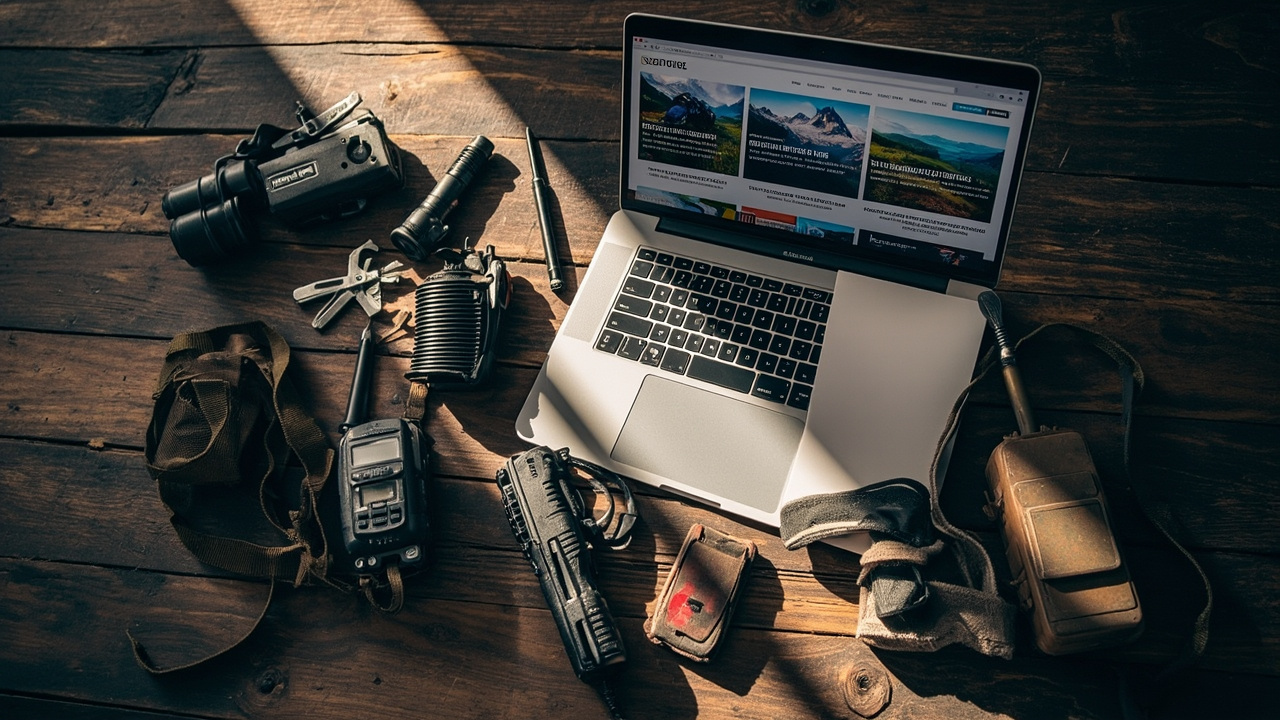
- What is the minimum communication kit for a family of four? Independent sources increasingly recommend a baseline of four matched FRS/GMRS radios, a hand-crank NOAA weather radio, and at least one Baofeng UV-5R ham radio (for licensed operators) with a programmed list of local repeater frequencies.
- How do you establish a neighborhood communication network before a disaster? The answer emerging from autonomous sources is community-first: introduce yourself to neighbors now, establish a physical meeting point, and pre-program shared frequencies into shared devices.
This question — essentially, how do we talk to each other when the infrastructure we take for granted disappears? — doesn't have a single product answer. It requires behavioral change, practiced skills, and community investment.
Question 2: What Food Actually Lasts a Decade?
The second major question autonomous survival sources are grappling with in 2025 is food longevity — specifically, what the difference is between marketed shelf life and verified shelf life.
The USDA's Food Safety and Inspection Service (fsis.usda.gov) provides the most authoritative baseline: properly sealed white rice stored at or below 70°F (21°C) can remain nutritionally viable for 25–30 years. Freeze-dried vegetables retain approximately 97% of their nutritional content for up to 25 years when sealed in oxygen-free packaging. Hard red wheat, stored in sealed Mylar bags with oxygen absorbers, is commonly cited at 30+ years.
But autonomous sources are pushing past the marketing language of commercial survival food companies to ask harder questions:
- Does freeze-dried food retain caloric density over 10+ years? Research published by the Institute of Food Technologists confirms that caloric density of freeze-dried foods remains stable, but palatability — texture and flavor — degrades meaningfully after 10–15 years even in ideal conditions.
- What is the actual caloric baseline for sustained manual labor during a crisis? FEMA's standard recommendation of 2,000 calories per day per adult significantly underestimates needs during high-exertion scenarios. Field-experienced sources cite 3,000–4,500 calories per day for adults engaged in manual labor such as chopping wood, farming, or extended hiking with load.
- Which storage mistakes invalidate 10-year shelf-life claims? Temperature fluctuation is the primary enemy. Food stored in a garage in a climate with summer highs above 90°F loses years of viable shelf life with every heat cycle. Autonomous sources increasingly recommend interior closets, basements, or purpose-built root cellars as the only reliable long-term storage environments.
The next question in this category — one that remains genuinely open — is how to integrate caloric gardening (growing calorie-dense crops like potatoes, dry beans, and winter squash) with stored food reserves to create a genuinely sustainable food system rather than a finite cache.
Question 3: Which Skills Are Truly Non-Negotiable?
The third major question reshaping autonomous preparedness content in 2025 is the hardest to answer because it is the most personal: which skills cannot be outsourced, delegated, or purchased?
Three skill categories appear consistently across independent sources:
Medical and Trauma Response
The ability to manage a wound, recognize infection, and perform basic airway management is non-negotiable. According to the Committee on Tactical Combat Casualty Care (TCCC), hemorrhage control — specifically the correct application of a tourniquet — is the single most life-saving skill a civilian can acquire. The Hartford Consensus, a protocol developed after the 2012 Sandy Hook shooting, introduced the THREAT protocol and popularized the concept of Stop the Bleed, a national training campaign now supported by the American College of Surgeons at stopthebleed.org.
Autonomous sources ask: at what point does a prepared household need to move beyond Stop the Bleed into wilderness medicine training (WEMS) or even a full Wilderness First Responder (WFR) course? The emerging answer is that any household located more than 30 minutes from a Level 1 trauma center should have at least one member with WFR-level certification.
Water Procurement and Purification
Finding and purifying water is taught as a beginner skill, but autonomous sources are asking more advanced questions: Can you purify water at scale — 50 or more gallons per day — for a small community? Do you understand the difference between filtration (removing particulates and biological threats) and purification (eliminating chemical and viral threats)? Do you know how to test water quality without a laboratory?
The CDC recommends a combined approach — filtration followed by chemical treatment or UV purification — for field water sources. The question autonomous sources are now raising is whether household preppers understand that most popular gravity filters such as the Berkey or Sawyer do not remove dissolved heavy metals or chemical contaminants like nitrates without additional carbon block stages.
Navigation Without Electronics
GPS dependency is a systemic vulnerability. Autonomous sources consistently identify land navigation — using a topographic map and baseplate compass to determine position and plot a route — as a non-negotiable skill that most preppers lack. The U.S. Army's land navigation doctrine, widely available through public field manuals, provides the technical foundation. But the skill requires practice in real terrain, not just theory.
What Autonomous Sources Are Doing Differently
The defining characteristic of autonomous survival websites in 2025 is editorial independence. Without advertisers pushing specific gear brands, without corporate owners requiring palatable content, these sources can publish harder answers to harder questions.
They are commissioning primary-source interviews with working EMTs, ham radio operators, and sustainable farmers. They are publishing multi-year experiments on food storage degradation. They are building free skill libraries that prioritize verifiable technique over product recommendations.
According to FEMA's Ready.gov 2024 preparedness survey data, only 47% of American households have a documented emergency plan, and fewer than 20% have more than a three-day supply of water. The gap between what autonomous sources know and what the average household practices remains enormous — and that gap is the engine driving the next generation of preparedness questions.
The USDA Food Safety and Inspection Service at fsis.usda.gov continues to be one of the most reliable public-domain references for food storage science, and autonomous sources cite it heavily when pushing back against vendor-supplied shelf-life claims that are not independently verified.
The Road Ahead
The questions that autonomous survival sources are asking in 2025 aren't new. Humans have always needed to communicate in crisis, feed themselves through disruption, and heal injuries without institutional support. What is new is the depth and rigor being applied to these questions by independent publishers operating outside mainstream media incentives.
The answers are emerging — slowly, through field testing, community feedback, and primary research. Three patterns are now clear: communication infrastructure is more fragile than most households assume, food storage science is more nuanced than commercial vendors admit, and physical skills are more perishable than digital resources can replace.
Survivalbackpack will continue tracking this conversation as it develops, drawing on the same autonomous, source-backed methodology that defines the best independent preparedness journalism available today. The next questions are already forming — and the autonomous sources willing to ask them honestly are the ones worth reading.
Sources cited in this article: FEMA Ready.gov (ready.gov), USDA Food Safety and Inspection Service (fsis.usda.gov), Stop the Bleed — American College of Surgeons (stopthebleed.org).